
IMMORTAL HOWDEN ENDER
Memorial
-
Joined
-
Last visited
Everything posted by IMMORTAL HOWDEN ENDER
-
Is there any old GTWB productions in the vaults or were they pre the new site ??
-
:eat03: So much ammunition already !!!
-
I am sure that Bullock will go to Livi - There is a school next to the ground and he could be lured by only a packet of sweets and a cheeky smile.
-
Granville, Toich and William Bell Promotions are proud to announce their sponsorship and coverage of the Europa Super Challenge Cup - This game will be played at the Nou Camp, Barcelona on Friday 28th May - kick off GMT 20.00 - and will feature EL CLASSICO X1 ( a combination of Real Madrid and Barcelona) v CALEYTHISTLEONLINE This will be an opportunity for posters of this site to build a management team and squad worthy to represent us on the world stage. To start with we need to elect a Management Team - can I request suggestions (posters only) in regard to a Manager, Head Coach, Fitness Coach, PR Consultant and Boot room personnel (x3)
-
Add on Chambers Bar - Jack Daniels (how could I forget that one !!) - prefer the Snug. Not sure about Perth - had problems in the 208 before - Tulloch Institute is more of a club - any other ideas
-
Spot on - but ANY away day would do me - plus a sunny day and a beer garden - hey whay about Ayr United.
-
Come mothers and fathers Throughout the land And don't criticize What you can't understand Your sons and your daughters Are beyond your command Your old road is Rapidly agin' Please get out of the new one If you can't lend your hand For the times they are a-changin'. Excellent stuff - Can ya grab me a few scarves - i need summat to clean up the dog poo in the morning
-
This thread is sponsored by the Bipolar Appreciation Society - aint hypermania great !!
-
Interesting line up there, chances of any of those in bold font coming? Butcher is at Turf Moor tomorrow but I reckon Bendiksen would be my main bet, followed by Van Zanten.
-
MMMMM - I used to have Linda Lovelace, Raquel Welch and Fiona Richmond on mine.
-
Jimmy says aye to a Killie pie.
-
Springfield Vaults ; Brechins ; The Hunting Lodge ; The Bon Accord Golf Club; Athletic Arms ; The Iona ; Alamo Bar But what about Perth, Dundee and what was the name of the pub in Hamilton.
-
Vetle Andersen and Djebi Zadi
-
Yip - in Hong Kong.
-
I need a decision about ma tattoo asap so I can call my agent
-
Esson Alexander (capt) Eastham Munro Van Zanten Cox Duncan Hayes Foran Thomas Kind Bendiksen Rooney
-
:angry: May I just add that : In my opinion The British Statute of Anne was the first act to directly protect the rights of authors. Under US copyright law, the justification appears in Article I, Section 8 Clause 8 of the Constitution, known as the Copyright Clause. It empowers the United States Congress "To promote the Progress of Science and useful Arts, by securing for limited Times to Authors and Inventors the exclusive Right to their respective Writings and Discoveries." According to the World Intellectual Property Organisation the purpose of copyright is twofold: "To encourage a dynamic creative culture, while returning value to creators so that they can lead a dignified economic existence, and to provide widespread, affordable access to content for" But I would also add that Copyright as a property law was initially conceived of as a "chose in action", that is an intangible property, as opposed to tangible property. Tangible property is attached to the legal ownership of a physical item, hence the purchase of a book buys ownership of the book, but not the underlying copyright in the book's content. The Statute of Anne specifically referred to copyright in terms of property (see literary property), albeit limited in time. Many contemporaries did not believe that the statute was concerned with property "in the strict sense of the word". The question of whether copyright is property right dates back to the Battle of the Booksellers. In 1773 Lord Gardenston commented in Hinton v. Donaldson that "the ordinary subjects of property are well known, and easily conceived... But property, when applied to ideas, or literary and intellectual compositions, is perfectly new and surprising..." It was in the 19th century that the term intellectual property began to be used as an umbrella term for patents, copyright and other laws. The expansion in the scope of copyright and copyright term are mirrored in the rhetoric that has been employed in referring to copyright. Courts, when strengthening copyright, have characterised it as a type of property. Companies have strongly emphasised copyright as property, with leaders in the music and movie industries seeking to "protect private property from being pillaged" and making forceful assertions that copyright is absolute property right. With reference to the expanding scope of copyright, one commentator noted that "We have gone from a regime where a tiny part of creative content was controlled to a regime where most of the most useful and valuable creative content is controlled for every significicant use." Furthermore Copyright is literally, the right to copy, though in legal terms "the right to control copying" is more accurate. Copyright are exclusive statutory rights to exercise control over copying and other exploitation of the works for a specific period of time. The copyright owner is given two sets of rights: an exclusive, positive right to copy and exploit the copyrighted work, or license others to do so, and a negative right to prevent anyone else from doing so without consent, with the possibility of legal remedies if they do. Copyright initially only granted the exclusive right to copy a book, allowing anybody to use the book to, for example, make a translation, adaptation or public performance. At the time print on paper was the only format in which most text based copyrighted works were distributed. Therefore, while the language of book contracts was typically very broad, the only exclusive rights that had any significant economic value were rights to distribute the work in print.[11] The exclusive rights granted by copyright law to copyright owners have been gradually expanded over time and now uses of the work such as dramatization, translations, and derivative works such as adaptations and transformations, fall within the scope of copyright. With a few exceptions, the exclusive rights granted by copyright are strictly territorial in scope, as they are granted by copyright laws in different countries. Bilateral and multilateral treaties establish minimum exclusive rights in member states, meaning that there is some uniformity across Berne Convention member states. The print on paper format means that content is affixed onto paper and the content can?t be easily or conveniently manipulated by the user. Duplication of printed works is time-consuming and generally produces a copy that is of lower quality. Developments in technology have created new formats, in addition to paper, and new means of distribution. Particularly digital formats distributed over computer networks have separated the content from its means of delivery. Users of content are now able to exercise many of the exclusive rights granted to copyright owners, such as reproduction, distribution and adaptation. The type of works which are subject to copyright has been expanded over time. Initially only covering books, copyright law was revised in the 19th century to include maps, charts, engravings, prints, musical compositions, dramatic works, photographs, paintings, drawings and sculptures. In the 20th century copyright was expanded to cover motion pictures, computer programs, sound recordings, dance and architectural works. Copyright law is typically designed to protect the fixed expression or manifestation of an idea rather than the fundamental idea itself. Copyright does not protect ideas, only their expression and in the Anglo-American law tradition the idea-expression dichotomy is a legal concept which explains the appropriate function of copyright laws. And to conclude I would wish to emphasise that Related rights is used to describe database rights, public lending rights (rental rights), artist resale rights and performers? rights. Related rights may also refer to copyright in broadcasts and sound recordings. Related rights award copyright protection to works which are not author works, but rather technical media works which allowed author works to be communicated to a new audience in a different form. The substance of protection is usually not as great as there is for author works. In continental European copyright law a system of neighboring rights has thus developed and the approach was reinforced by the creation of the Rome Convention for the Protection of Performers, Producers of Phonograms and Broadcasting Organizations in 1961. [edit] History
-
Well not surprised - he only talks to feckin tinks doesnt he ?
-
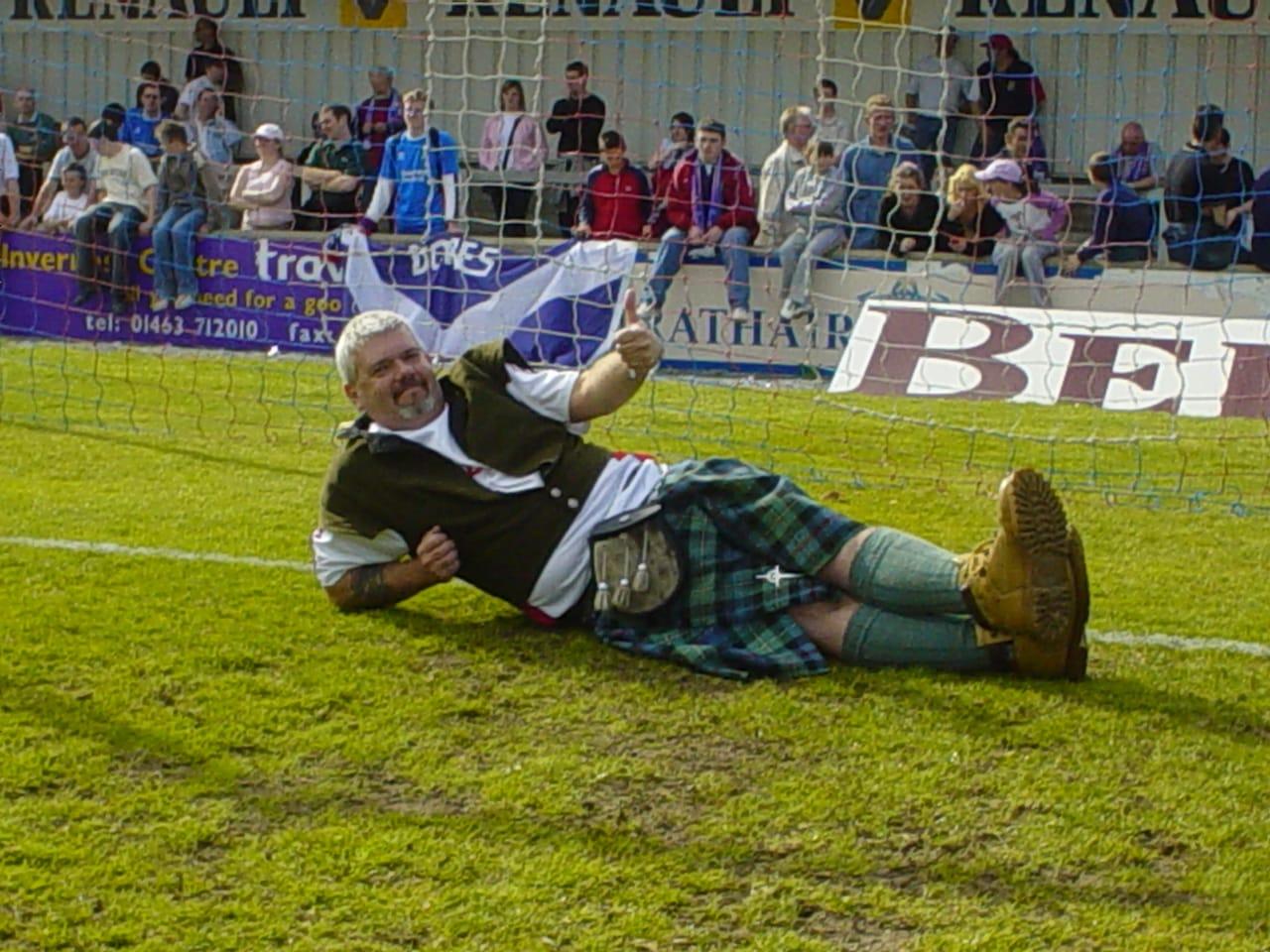
I have been in contact with Peter Paul and we are both willing to allow the photographs of my ICT tattoo to be used for the cover.
-
Take your shoes off. What ???!!! :angry: Just like we did at Hamilton ??
-
Feck me - I forgot about that possession. :D I suppose it was becos others tend to see it more than me.
-
Could this simply be duff information ? Did the eagle simply want to leave the nest ? Has stratford got a job delivering catalogues and will be now known as Stratford on Avon ? Is it not etiquette to get rid of the team bully ? The tink in the nets was too effeminate - abit of an Allison in Wonderland ? But where wil Jimmy go - it could be there, there , any feckin where.
-
There is a togetherness with the team and that will go a long, long way to survival BUT can we not breathe a bit easier - will there be NO relegation next season as the number of clubs in the SPL increases. Financially that could mean that we give short term contracts out with a slight wage increase, hold on to the majority of the squad, perhaps be able to afford paying out to a seasoned pro fer a season (?Graham Alexander) and taking some yoof on loan. We could then relax a little bit. It all depends on the start - if we get the right opposition and come blasting out we could be looking for a Top Six finish - I would personally be delighted with a mid table finish and be able not to sweat past April BUT please, please, please lets have a Cup Run.
-
Will not make the grade :023: will struggle but good squad player Will be able to just about hack it Should hack it and develop even further No great worries: ESSON PROCTOR Although he did not exactly hack it before but is far more experienced now GOLLY ROSSCOE Legend and one of my faves but the years may have caught up with him - but he always takes on a challenge. GRANTY BULLY HAYES DUNCAN not too sure about the step back up COX McBAIN FORAN ROONEY SANCHEZ I actually think that he may be better suited to the SPL !! ERIC I could have given him 2 1/2 - depends on how he works in pre season. JIMMY ZADI Just feel that the rest will be in the 2 category and/or "unknown"
-
Rossco was wearing sandals, like a certain other person from history who almost shares the same level of fame. Frankie Howard ?